A Night in the Sahara Desert in Morocco: What Really Happens
 By Youssef Ettaghlaoui, Founder and licensed local guide · Updated
A night in the Sahara in Morocco, at Erg Chebbi near Merzouga, goes like this: late in the afternoon you ride a camel for about 1 hour 20 minutes into the dunes (or go by 4×4), stop on a dune for the sunset, and reach a tented camp where your luggage is waiting. You have tea, dinner and an evening of drums and stars, you sleep in a tent with its own bathroom, you climb a dune for the sunrise, and you are back in the village by about 9 am. Inside a winter tent it can be 5 to 6 °C (41–43 °F), sometimes 0 °C, so bring a jacket. The stars are not guaranteed.
I was born near these dunes and I have taken travelers into them since I was 16. Below is the night hour by hour, with the real temperatures, the three camps we use, what to pack and what it costs, including the things most guides leave out.
- Where
- Erg Chebbi, Merzouga, Morocco
- Ride to camp
- 1 h 20 by camel, or 4×4
- Winter tent
- 5–6 °C, sometimes 0 °C
- Camp night for two
- $150–$450, Oct 2026
The Night in Short
| Where | Erg Chebbi, the Sahara dunes next to Merzouga, in southeastern Morocco |
|---|---|
| Getting to camp | Camel ride of about 1 h 20 to 1 h 30, or a 4×4. Your luggage goes ahead by 4×4 |
| What you sleep in | A tent with a bed, blankets and a private toilet and shower with hot water, at the three camps we use |
| Dinner | Salad, soup, a main dish and fruit; about 1 litre of water included |
| The evening | Tea, dinner, a fire, drums and Berber songs, then the stars |
| The morning | Wake-up just before sunrise, a dune climb, breakfast, back to the village by camel or 4×4 |
| Winter tent | 5–6 °C (41–43 °F), sometimes 0 °C (32 °F) |
| Summer tent | About 30–35 °C (86–95 °F) |
| Camp night for two | $150 (standard), $270 (mid-range), $450 (premium); checked 29 October 2026 |
| Not guaranteed | A clear sky, calm wind, a quiet camp if you choose a busy one |
Is a Night in the Sahara Worth It?
Yes, if you can give it the time. The ride in, the silence, the stars and the sunrise on the sand are what travelers remember, more than any monument. It is also simpler than most people fear: the bathroom is in your tent, and your luggage is waiting at camp.
It is not for everyone. The desert is far from Marrakech and Fes (at least three days for the whole trip), the night is cold in winter and hot in summer, and there is no phone signal you can rely on. If you only have an afternoon or one night near Marrakech, read Agafay or the Sahara first: Agafay is a rocky desert 40 minutes from the city, not a dune desert.
Which Sahara? The word covers a vast area across many countries, and photos of other places are mixed into the search results. This guide is only about Erg Chebbi in Morocco, the dunes I grew up beside. For the place itself, see our Erg Chebbi guide; for Morocco’s other dune sea, read Erg Chebbi or Erg Chigaga: which to choose.
The Night Hour by Hour
The schedule moves with the sun. These are the times we follow, in winter and in summer. Meeting, dinner, music and breakfast times are typical, not fixed; sunset and sunrise are calculated (see the table below).
A winter night (November to February)
| When | What happens |
|---|---|
| 4:00–4:30 pm | You meet your camel leader at the edge of the village. Your luggage goes ahead to camp by 4×4. You carry your phone, water and a jacket |
| About 4:30 pm | The camel ride starts, about 1 hour 20 to 1 hour 30 into the dunes |
| About 5:15 pm | Sunset from a dune on the way (calculated: about 5:15 to 5:35 pm from November to January) |
| On arrival | Tea. You are shown your tent, and you can shower. Your bags are already there |
| 6:45–7:00 pm | Dinner starts and ends about 8:00–8:30 pm |
| Until about 10 pm | A fire, drums and Berber songs |
| 10 pm to 11 pm or midnight | Stargazing, with the camp lights switched off |
| Just before sunrise | You are woken 10 to 15 minutes before the sun. Climb the nearest dune |
| After sunrise | Breakfast, then back to the village by 4×4 (or camel, if you prefer) |
In midwinter the sun rises after 7 am (see the table), so the morning starts later than in spring or autumn. We confirm the return time with your quote.
A summer night (June to August)
| When | What happens |
|---|---|
| About 5:30 pm | The camels leave the village, with your luggage going ahead by 4×4 |
| About 7:20 pm | Sunset from a dune on the way (calculated: 7:20 pm in June and July) |
| 8:00–8:30 pm | Dinner |
| Until 11 pm or midnight | Music and a fire, then stargazing and sleep |
| Just before sunrise | Wake-up 10 to 15 minutes before the sun, about 5:00 am (calculated sunrise 5:11–5:22 am) |
| 7:00–8:00 am | Back at the village after breakfast |
Summer 2027 is the first summer on Morocco’s new clock, so these summer times are our usual schedule moved one hour earlier, with the sun. We confirm them with your quote.
Sunset and sunrise at Merzouga, by month
| Month (15th) | Sunrise | Sunset |
|---|---|---|
| January | 7:15 am | 5:35 pm |
| February | 6:58 am | 6:02 pm |
| March | 6:28 am | 6:24 pm |
| April | 5:49 am | 6:43 pm |
| May | 5:21 am | 7:03 pm |
| June | 5:12 am | 7:21 pm |
| July | 5:22 am | 7:22 pm |
| August | 5:41 am | 7:00 pm |
| September | 5:59 am | 6:23 pm |
| October | 6:18 am | 5:46 pm |
| November | 6:43 am | 5:19 pm |
| December | 7:07 am | 5:16 pm |
Calculated for Merzouga with the standard solar formula, in Morocco time. Morocco has been on GMT all year since September 20, 2026, and the clocks no longer change for Ramadan.
The Ride to Camp: Camel or 4×4
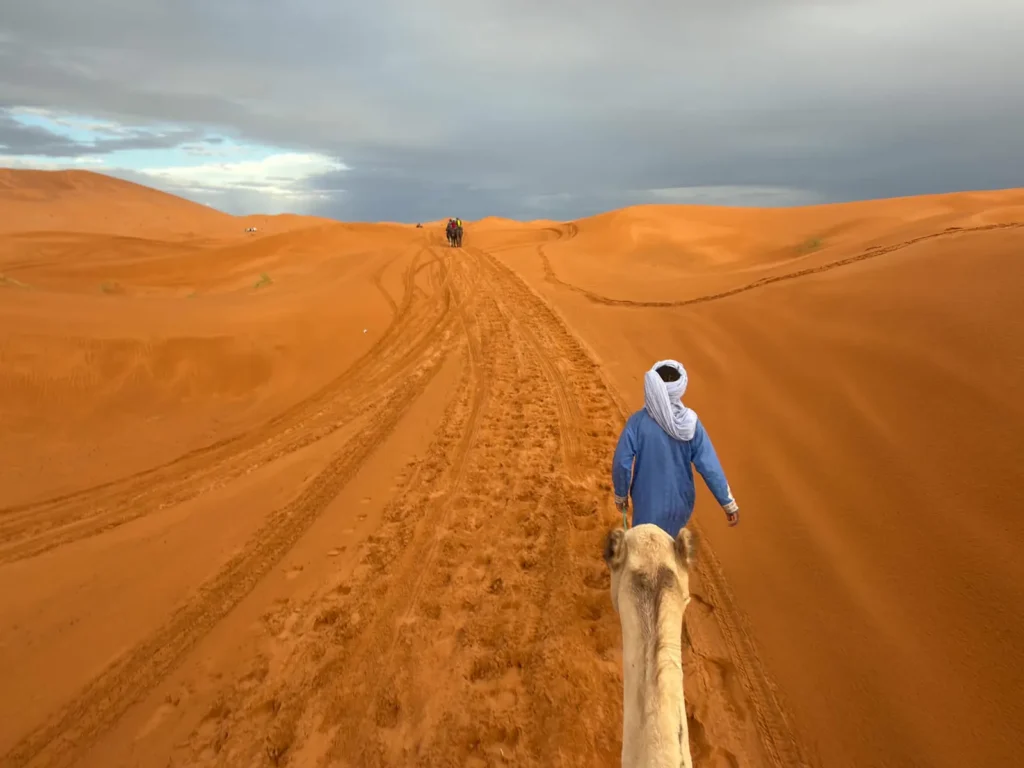
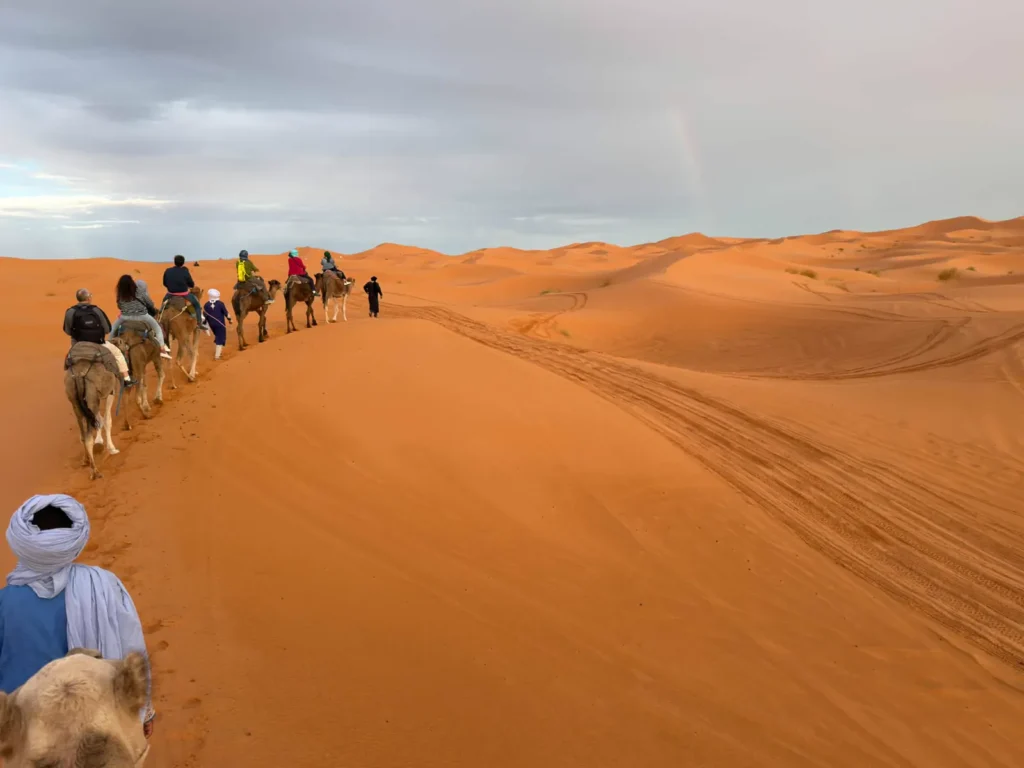
The camel ride takes about 1 hour 20 to 1 hour 30 and stops on a dune for the sunset. You keep your phone, water and a jacket with you; the suitcases travel separately by 4×4 (usually a Toyota Hilux) and are already in your tent when you arrive.
You do not have to ride:
- If you cannot or would rather not ride a camel, we take you to camp by 4×4.
- Children who want to try can ride with a parent or relative on the same camel.
- If walking or mounting is difficult, the camel leader, a helper and the camp staff can help you on and off. We check what is safe for you before we promise a ride, so tell us when you ask.
On a windy day we may change the order, as explained in the wind section below. If you are coming from Marrakech, our Marrakech to Merzouga guide explains how the drive and the first night fit together.
The Tent, the Bed and the Bathroom
People imagine a sleeping bag on the sand. A camp tent in Erg Chebbi has a bed with blankets, electric light and charging, and a private toilet and shower with hot water. These facts are for the three camps we use, one in each category. Other camps differ, so ask before you book anywhere.
| Shooting Stars Camp | Sahara Eden Camp | Tiziri Camp | |
|---|---|---|---|
| Category | Standard | Mid-range | Premium |
| Tents | 10 | 12 | 6 |
| Bathroom | Private, in the tent, hot water | Private, in the tent, hot water | Private, in the tent, hot water |
| Winter heating | No; warm blankets | Yes | Yes |
| Summer air conditioning | No | Yes | Yes |
| Phone signal | Weak | Yes | Yes |
Wi-Fi and signal can be slow anywhere in the dunes: plan on being offline. Camp electricity can be solar, so bring a power bank and your cables.
A quiet camp
Some camps host large shared groups, with quad bikes, loud music and generators running at night, especially with young groups. I know the camp owners and their usual guests, so I choose camps that mostly host private travelers and sit away from the group camps. If a quiet night matters to you, tell us when you ask for a price, and ask any camp you book on your own about groups and generators.
The three camps are compared in more detail, with a map, in the Erg Chebbi guide; our camp products are on the luxury desert camps page.
How Cold or Hot Is It?
| Winter, inside the tent | About 5–6 °C (41–43 °F), sometimes 0 °C (32 °F) |
|---|---|
| Winter, outside at night | It can reach 0 to −3 °C (32 to 27 °F) |
| Summer, in the tent | About 30–35 °C (86–95 °F) |
These are my estimates from years of camp nights, not readings from a thermometer, and they change with the weather of the week. The desert cools fast after sunset because the dry air holds little heat and the sand gives it back quickly. The days can be warm even when the night is cold.
In winter, every camp gives you winter blankets, but only some camps heat the tent. Ask for a camp with a heater: our mid-range and premium camps have one, the standard one does not. In summer, air conditioning is what makes sleeping easy, and again the mid-range and premium camps have it. The best months for the Sahara are late August to mid-December and mid-January to late June. For the rest of the country, see the best time to visit Morocco.
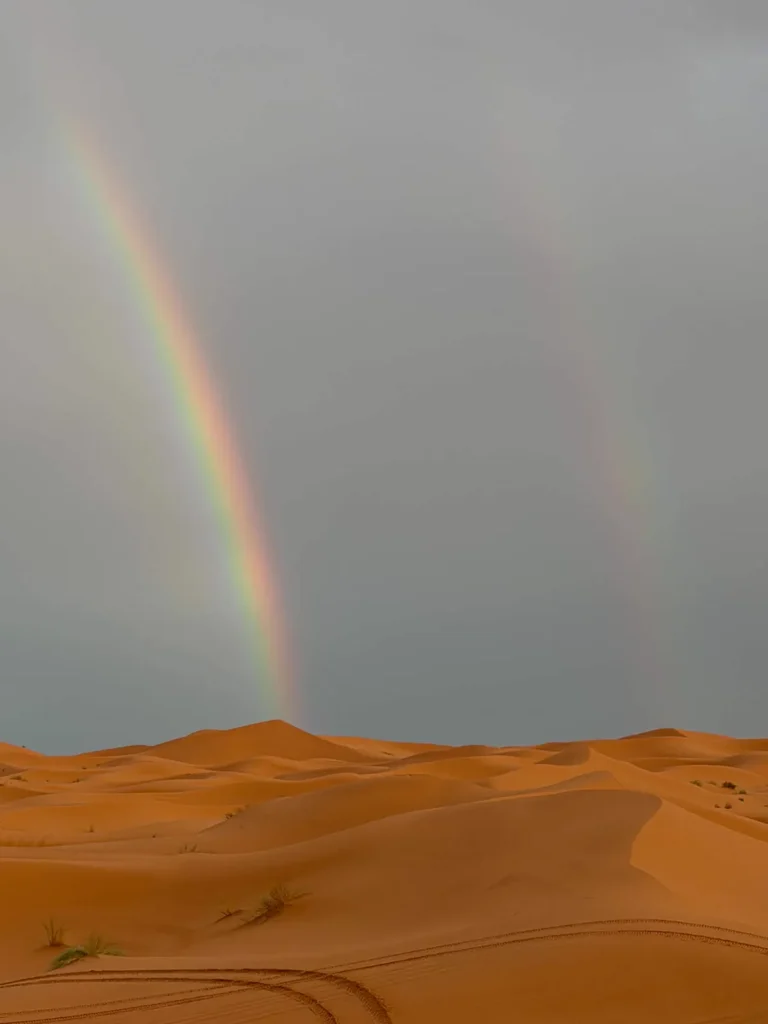
Rain is rare, but it happens, sometimes with floods, and sometimes with rainbows like the one in this photo.
Dinner, Music and the Stars
Dinner
Dinner is a salad and soup, a main dish with rice, vegetables and meat or chicken, then fruit or dessert, with about one litre of bottled water. Other drinks are extra. Vegetarian and children’s meals and food allergies can be arranged if we tell the camp in advance. We cannot promise allergen-free cooking, so say what matters when you ask. Breakfast has hot and cold items with several choices.
The evening
After dinner there is a fire and drums with Berber songs, and you are welcome to join in. In winter it usually ends around 10 pm; in summer it can go on until 11 pm or midnight. Then the camp lights go off for the stars.
The stars
I cannot promise you a clear sky in any season. Cloud, rain and wind are the main problems, and in my experience you can still see stars under a full moon. The density of the stars is one of the things that surprises our travelers most, along with how comfortable the tents are. In my experience the Milky Way is visible from June to August; that is a memory, not a guarantee.
Small visitors
After dark, small animals appear around camp: cats, and sometimes fennec foxes, the long-eared foxes that spend the day in their burrows.
Wind, Sandstorms and Our Plan B
Strong wind and sandstorms are most common from late June through July and August. They usually start around midday and can last into the evening, sometimes until about 7 to 9 pm. Mornings are often calmer.
When the wind makes the sunset camel ride impractical, we drive you to camp by 4×4 and keep the camel ride for the next morning if you want it. In the evening you stay in your tent or in the camp restaurant, where dinner, the fire and the music can be moved indoors. The cost is the stargazing: on a windy night you may not see the sky well. I cannot give you a fixed rule for how often it happens or a formal cancellation policy, so ask us about the month you are planning.
What to Pack for One Night
You need very little, because your suitcase waits at camp. For the ride, keep a small bag.
| Bring | Why |
|---|---|
| A warm jacket | The item travelers forget most often. Keep it with you for the ride: it is cold after sunset in winter |
| Boots and warm, heavy clothes (winter) | For the cold night and the sand |
| Loose, light clothes (summer) | For the ride and the heat |
| A power bank and cables | Camp electricity may be solar |
| Water, phone, camera | For the ride; the rest goes ahead by 4×4 |
Snakes, Scorpions and Other Worries
Travelers often ask about snakes and scorpions, and about walking to the toilet in the dark. Here is what I can say honestly.
- Snakes and scorpions: in all our years we have had no incident with a guest. In my experience snakes keep away from the busy, noisy parts of a camp. Cats live around the camps. I cannot say there is no risk in a desert, and I will not.
- The toilet at night: at the camps we use, the toilet and shower are private and inside your tent, so you do not walk across the camp.
For safety in the country more broadly, see Is Morocco safe?
What a Night in the Sahara Costs
This is the price of the camp night alone, the total for two people for one night, checked on 29 October 2026. It includes the camel ride to camp and back (or a 4×4 if you prefer), dinner, breakfast and sandboarding.
| Camp | Category | Night for two |
|---|---|---|
| Shooting Stars Camp | Standard | $150 |
| Sahara Eden Camp | Mid-range | $270 |
| Tiziri Camp | Premium | $450 |
Extras
| Quad bike, 1 hour | $50 per person |
|---|---|
| Buggy, 1 hour | $170 for two |
| Horse riding, 1 hour | $35 per person |
| Extra camel ride, 1 hour | $25 per person |
| 4×4 tour around the dunes, about 4 hours | $130 for two |
Prices can change, so ask for the current price. We book these camps at trade rates and have no commission agreement with any of them. On our Sahara desert tours the camp night is part of the trip and is quoted with it. If you are weighing it up, our 3-day tour from Marrakech to Merzouga is the shortest trip with one night in the dunes.
If You Want Something Different
A camp is not the only way to spend a night in the dunes. We arranged a night with a nomad family for a couple from Poland who wanted something more authentic than a camp; we can do it again when a family agrees to host. A second night in the dunes also gives you time for more sandboarding, a quad ride and a visit to a nomad family. Ask us. The Erg Chebbi guide has the details.
Trips with a Night in the Sahara
Every trip is private and can be changed: a second night in the dunes, a finish in Fes, or a different camp.
-
 3 days
3-Day Marrakech to Merzouga Desert Tour
Over the High Atlas to the dunes of Erg Chebbi and back: our most requested desert trip from Marrakech.Private tour · Price on request -
 4 days
4-Day Sahara Desert Tour from Marrakech
Merzouga and Erg Chebbi from Marrakech with the drive split into four easy days and a night in Ouarzazate on the way back.Private tour · Price on request -
 3 days
3-Day Marrakech to Fes Desert Tour
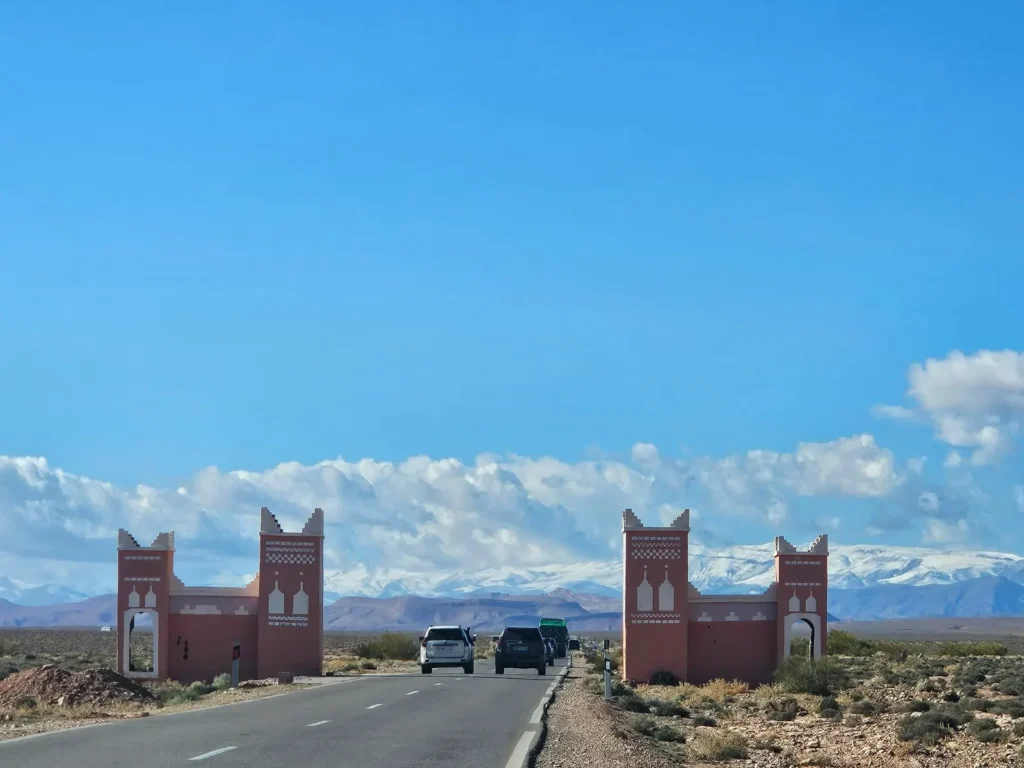
The desert on the way between two cities: over the Atlas to the Merzouga dunes, then north to Fes.Private tour · Price on request -
 5 days
Luxury Sahara Desert Tour from Marrakech
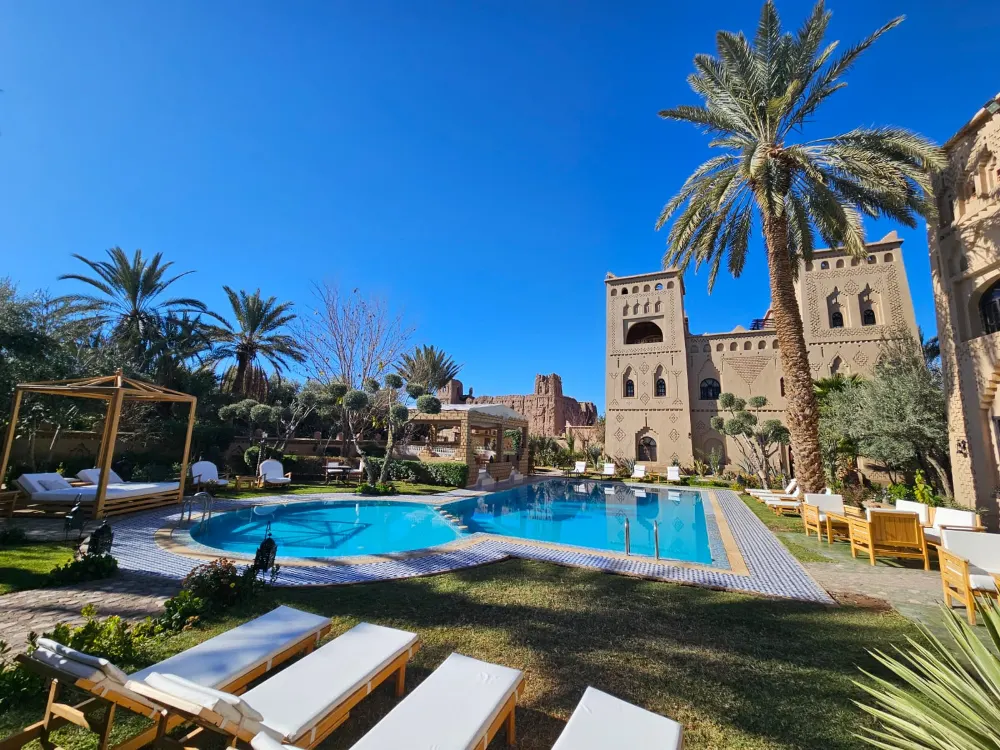
A private 4×4, boutique kasbah hotels and two nights in a luxury tent in the Erg Chebbi dunes.Private tour · Price on request
A Night in the Sahara: Questions
Still deciding? Ask us on WhatsApp: we reply from Merzouga, usually the same day.
How cold is the Sahara at night?
In winter at Erg Chebbi, inside a camp tent it is usually about 5–6 °C (41–43 °F) and sometimes 0 °C (32 °F); outside it can reach 0 to −3 °C (27 °F). In summer a tent is about 30–35 °C (86–95 °F). These are our guide’s estimates, not measurements.
Is it safe to sleep in a desert camp?
At the camps we use, you sleep in a tent with a private bathroom. Snakes and scorpions are a common worry; we have had no incident with a guest, but we cannot say there is no risk in a desert.
What do you sleep in at a Sahara camp?
In a tent with a bed and blankets. At the three camps we use, each tent has a private toilet and shower with hot water. Two of the three also have heating and air conditioning.
Can you see the stars from a Sahara desert camp?
Often, but never for sure. Cloud, rain and wind are the main obstacles. The camp switches off its lights for stargazing, and the Milky Way is usually visible from June to August when the sky is clear.
Can children and people who cannot ride a camel go?
Yes. Children can ride with a parent on the same camel, and anyone who cannot or would rather not ride goes to camp by 4×4. If mobility is limited, camp staff and the camel leader can help; we check what is safe for you first.
How much does a night in the Sahara cost?
For a camp night alone in Erg Chebbi, with the camel ride, dinner, breakfast and sandboarding, the total for two people on 29 October 2026 was $150 at a standard camp, $270 at a mid-range camp and $450 at a premium camp.
What happens if there is a sandstorm?
Sandstorms are most common from late June to August, usually from midday into the evening. If the wind is too strong for the camel ride, we take you to camp by 4×4 and you ride in the morning. Dinner and music move indoors.
What should I pack for a night in the desert?
A warm jacket, which is what travelers forget most, boots and warm clothes in winter, loose clothes in summer, a power bank and cables, water and your phone. Your suitcase goes ahead to camp by 4×4.
Which country is the Sahara desert in?
The Sahara spans many countries. This guide is about the part in Morocco: Erg Chebbi, a field of dunes near Merzouga in the southeast, on the northwestern edge of the Sahara.
Plan Your Night in the Sahara
Tell us your dates, how many you are and the camp level you like. We reply within 24 hours with a plan and a price.