Merzouga Weather by Month, and the Best Time to Go
 By Youssef Ettaghlaoui, Founder and licensed local guide · Updated
Merzouga weather is dry for most of the year, with a big difference between day and night. On average, days go from about 62 °F (17 °C) in January to 107 °F (41 °C) in July, and nights from about 38 °F (4 °C) to 80 °F (26 °C). My favorite periods are late August to mid-December and mid-January to late June, and above all March, April and October. July and August are only for travelers who handle strong heat: the hottest day I have known at Merzouga was 50 °C (122 °F).
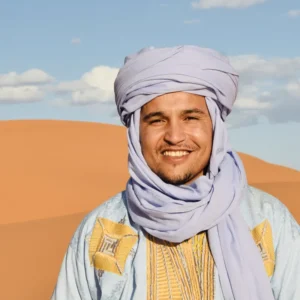
I was born near the Erg Chebbi dunes and I have worked in them since I was a camel leader at 16. Below is each month the way I advise my own guests: the averages next to what I see, the wind, the rain, the crowds and what a camp night costs in each season.
- My favorite months
- March, April and October
- Hottest
- July and August
- Coldest nights
- Mid-December to mid-January
- Book ahead
- 5–6 months for April, October and New Year
Merzouga Weather by Month
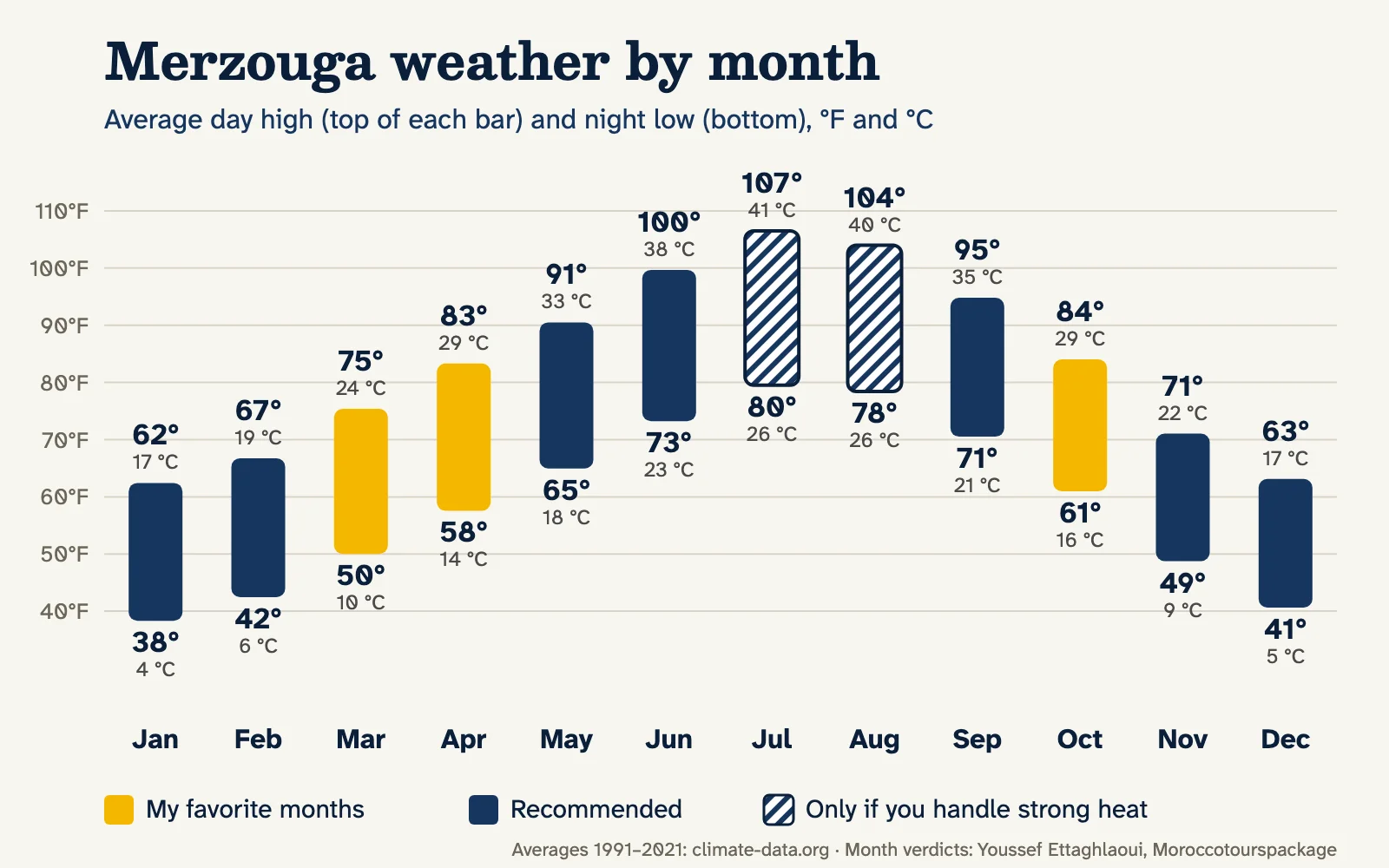
| Month | Average day high | Average night low | My advice |
|---|---|---|---|
| January | 62 °F (17 °C) | 38 °F (4 °C) | Yes. Cold nights: bring warm clothes |
| February | 67 °F (19 °C) | 42 °F (6 °C) | Yes, with warm clothes for the evening |
| March | 75 °F (24 °C) | 50 °F (10 °C) | Yes. One of my favorites |
| April | 83 °F (29 °C) | 58 °F (14 °C) | Yes, without hesitation. One of my favorites, and one of the two busiest months |
| May | 91 °F (33 °C) | 65 °F (18 °C) | Yes. Fewer tourists than in April |
| June | 100 °F (38 °C) | 73 °F (23 °C) | Yes, and quieter |
| July | 107 °F (41 °C) | 80 °F (26 °C) | Only if you handle strong heat |
| August | 104 °F (40 °C) | 78 °F (26 °C) | Only if you handle strong heat |
| September | 95 °F (35 °C) | 71 °F (21 °C) | Yes |
| October | 84 °F (29 °C) | 61 °F (16 °C) | Yes. One of my favorites, and one of the two busiest months |
| November | 71 °F (22 °C) | 49 °F (9 °C) | Yes, and quieter |
| December | 63 °F (17 °C) | 41 °F (5 °C) | Yes. Quiet early in the month; colder from mid-December, and busy at New Year |
The averages come from climate-data.org (1991–2021) for Merzouga. They are averages, not a forecast: a given week can be several degrees warmer or colder. My own figures from the dunes are in the seasons below. They are my estimates from experience, not measurements.
The Best Time to Visit Merzouga
My favorite periods are late August to mid-December and mid-January to late June. Within them, if you can choose, come in March, April or October.
April and October are also the busiest months at Erg Chebbi, so book five to six months ahead. If you want fewer people, May is a good choice: in my experience about 28–30 °C (82–86 °F) in the day and 19–22 °C (66–72 °F) at night, with fewer tourists than in April.
There is no month I would tell everyone to avoid. But mid-December to mid-January is the coldest time, which is why I leave it out, and July and August are the hottest. If you do not handle strong heat, choose another month than July or August.
Merzouga in Spring (March to May)
March and April are two of my three favorite months. In my experience, March days are about 25–30 °C (77–86 °F). April days are about 28–33 °C (82–91 °F) and nights about 15–20 °C (59–68 °F). In May the days are about 28–30 °C (82–86 °F) and the nights 19–22 °C (66–72 °F).
Many websites call spring the sandstorm season. At Erg Chebbi, in April I change a camel ride because of the wind perhaps once in a month, or not at all. Spring is not always calm, though: see the windy day in March below.
April is busy. Book five to six months ahead, and nine to twelve months ahead for a large group.
Merzouga in Summer (June to August)
June is still a month I recommend, and it is quieter. July and August are different. In my experience the days are 40–45 °C (104–113 °F) and the nights stay at 30–34 °C (86–93 °F). The hottest day I have known here was 50 °C (122 °F).
A summer day on our trips goes like this. You drive from the Dades Valley in the morning and reach Merzouga at about 3 to 4 pm. You rest at a hotel, change and swim, and then we collect you for the camel ride at sunset. The ride is late because the sand is too hot in the middle of the day: last summer it was too hot for bare feet from about 11 am to 6 pm.
Not every camp opens in high summer. Of the three camps we use, only Shooting Stars, our standard camp, is open in July and August; Sahara Eden and Tiziri close for those two months. On the new clock, the camels leave at about 6:00 pm in summer and dinner is at about 8:00 pm. In summer I also notice more wind, sometimes from around noon (see below).
Who should choose another month: anyone who does not tolerate extreme heat. Who can still come: travelers who can only travel in the summer holidays. It works, especially with air conditioning and a swimming pool at your hotel. Italian and Spanish travelers, for example, come to us in summer.
Merzouga in Autumn (September to November)
From late August I recommend the desert again, and September too. October is one of my three favorite months, and with April the busiest, so book it five to six months ahead. November is quieter.
In October, the Erfoud date festival is worth planning around if it falls in your dates (ask us for this year’s exact dates).
Merzouga in Winter (December to February)
From mid-December to mid-January, the coldest time of the year, the days are about 16–20 °C (61–68 °F) in my experience. The nights are cold: around 5–10 °C (41–50 °F) outside, on the coldest nights down to 0 or even −3 °C (27 °F), and I have seen frost and ice on water. I have never seen snow on the dunes. February days are about 15–25 °C (59–77 °F), with nights of 5–10 °C (41–50 °F).
The camps give you blankets, and more if you ask. In the standard camp, which has no heater, the hot shower is not the problem: the cold air is, when you step out of the bathroom. If you feel the cold, choose Sahara Eden or Tiziri: both have heating. The camps are described on our Erg Chebbi guide.
Pack warm clothes, boots and above all a jacket: it is the thing travelers forget most. On the way, snow on the High Atlas pass can delay the drive or force a detour, mostly in late November and early December and sometimes in January and February; our Marrakech to Merzouga guide explains what we do then.
Wind and Sandstorms: When They Really Come
At Erg Chebbi I notice the wind most from late June through July and August. It sometimes starts around noon and can last into the evening, while the mornings are often calmer. July is irregular: windy days and calm days, and sometimes two windy days in a row. In April, as I said, a change because of the wind is rare.
A strong wind can still come in spring. In late March, a Spanish family was with us when the wind was too strong for the sunset camel ride, and we cancelled it. The children were frightened at first. Later they enjoyed it, and saw the wind as part of the adventure.
When the wind is too strong for the camels, we drive you to camp by 4×4 and you ride in the morning instead. A night at camp, hour by hour, is in A Night in the Sahara Desert.
Does It Rain in Merzouga?
Yes, sometimes. In my experience the rain is irregular: there is no fixed rainy month. The averages show how little it is, about 53 mm (2.1 in) in a whole year. When it does rain, the desert is beautiful, and the photographs too.
The lake near Merzouga has had some water since 2023, and it filled up a lot after the floods of September 2024. The roads we use on our tours are generally not affected by the rain.
Sunset, Sunrise and Morocco’s New Clock
Since September 20, 2026, Morocco has been on GMT all year, one hour earlier than before, and the clocks no longer change for Ramadan. Calculated for Merzouga on the new clock, the sun sets at about 5:16 pm in mid-December and about 7:20 pm in June and July.
The camel ride follows the sun. In winter our guests meet the camels at about 4:00 to 4:30 pm. In summer the camels leave at about 6:00 pm, and dinner is at about 8:00 pm. The full table of sunrise and sunset times by month is in A Night in the Sahara Desert.
Crowds, Holidays and Camp Prices by Season
Busiest: April and October. Quieter: November, early to mid-December, late January, June, July and August. Book five to six months ahead for April, October and New Year’s Eve, and nine to twelve months ahead for a large group.
The camp night costs the same at Easter as the rest of the year, and Shooting Stars, the only one of the three open in July and August, keeps its normal rate in summer. Only New Year’s Eve costs more, when the camps hold a festive dinner with music.
| Camp night for two | Normal rate (also at Easter) | New Year’s Eve |
|---|---|---|
| Shooting Stars Camp (standard) | $150 | $200 |
| Sahara Eden Camp (mid-range, closed July and August) | $270 | $300 |
| Tiziri Camp (premium, closed July and August) | $450 | $500 |
Prices are the total for two people for one night, as of November 2026; what each night includes is on our Erg Chebbi guide. We book these camps at trade rates and have no commission agreement with any of them. A private three-day trip from Marrakech may cost less in July and August, even though the camp rates do not go down. Every trip is quoted on request: see what sets the price of a Morocco trip.
Ramadan, Festivals and Summer Weddings
Ramadan is expected to begin around February 8 in 2027, depending on the moon. Tours run as usual: our drivers keep their normal schedule while they fast, and the desert camps serve meals and run their activities as on any other day. Some local cafés and restaurants close during the day, but you can still find meals.
Festivals: the date festival in Erfoud, in October, and the Gnawa music festival in Khamlia, in August, are both worth planning around. Their exact dates change, so ask us for this year’s.
Weddings: summer is wedding season. If a family welcomes you, you may be able to see a traditional Amazigh wedding.
Stars in Every Season
In my experience the sky is clearest in the months I recommend and in summer. A full moon does not stop you enjoying the stars, in my experience. The camps switch off their lights for the stargazing. But cloud, rain and wind can hide the sky in any season, so I never promise a clear night.
How Long to Stay in Merzouga
I recommend two to three nights in Merzouga. One night at a camp is enough to feel the desert; with more time you can add a night in the village, a 4×4 day around the dunes or a second desert night. From Marrakech, the trip takes at least three days: see our Sahara desert tours from Marrakech, or, for the drive itself, the Marrakech to Merzouga guide. For the rest of Morocco month by month, read the best time to visit Morocco.
Before you choose your month, my advice is simple: read about the season, then choose a company that can give you the trip you want in it.
Desert Trips for Any Season
Every trip is private, so we set the times around the season: early starts and late camel rides in summer, warm camps in winter.
-
 3 days
3-Day Marrakech to Merzouga Desert Tour
Over the High Atlas to the dunes of Erg Chebbi and back: our most requested desert trip from Marrakech.Private tour · Price on request -
 4 days
4-Day Sahara Desert Tour from Marrakech
Merzouga and Erg Chebbi from Marrakech with the drive split into four easy days and a night in Ouarzazate on the way back.Private tour · Price on request -
 3 days
3-Day Marrakech to Fes Desert Tour
The desert on the way between two cities: over the Atlas to the Merzouga dunes, then north to Fes.Private tour · Price on request -
 5 days
Luxury Sahara Desert Tour from Marrakech
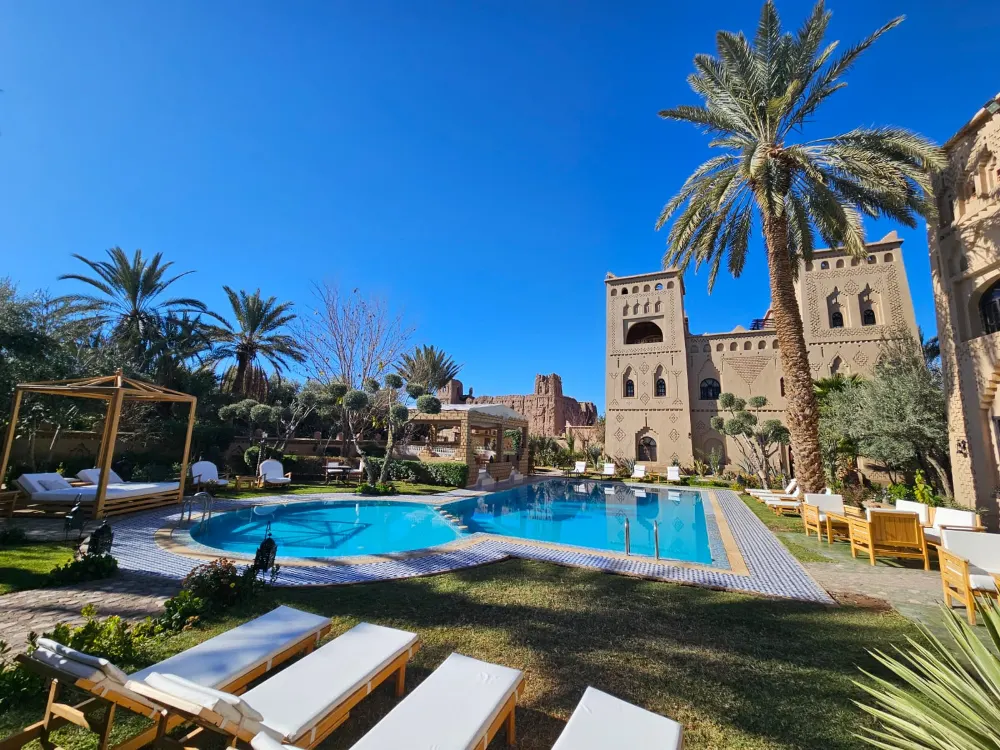
A private 4×4, boutique kasbah hotels and two nights in a luxury tent in the Erg Chebbi dunes.Private tour · Price on request
Merzouga Weather: Questions
Still deciding? Ask us on WhatsApp: we reply from Merzouga, usually the same day.
What is the best month to visit Merzouga?
Our guide Youssef’s favorite periods are late August to mid-December and mid-January to late June, and above all March, April and October. April and October are also the busiest, so book five to six months ahead; May has fewer tourists than April.
Does it rain in the Merzouga desert?
Yes, but rarely and irregularly: there is no fixed rainy season, and the average is about 53 mm (2.1 in) a year. Rain makes the desert especially beautiful, and the lake near Merzouga has had water since 2023, filling up a lot after the September 2024 floods.
Does Merzouga get cold at night?
Yes, especially in winter. Nights outside are around 5–10 °C (41–50 °F), on the coldest nights down to −3 °C (27 °F), and frost or ice on water can happen. Camps give you blankets, and more on request; Sahara Eden and Tiziri also have heating.
How hot is Merzouga in summer?
In July and August, days are about 40–45 °C (104–113 °F) in our experience, and the nights stay warm, 30–34 °C (86–93 °F). The hottest day Youssef has known at Merzouga was 50 °C (122 °F). Camel rides move to the late afternoon and the sunset.
Is May a good time to visit Merzouga?
Yes, it is a month we highly recommend: about 28–30 °C (82–86 °F) in the day and 19–22 °C (66–72 °F) at night in our experience, with fewer tourists than in April.
Which month should I avoid for the Sahara in Morocco?
There is no month we tell everyone to avoid. But if you do not tolerate extreme heat, avoid July and August. Travelers who can only come in the summer holidays can still go, especially with air conditioning and a swimming pool at your hotel.
When is sandstorm season in Merzouga?
At Erg Chebbi we notice the wind most from late June to August, sometimes from around noon, with calmer mornings. In April a camel ride is changed because of the wind perhaps once a month, or not at all, although strong wind can still come in spring. When the wind is too strong, we go to camp by 4×4 and ride in the morning.
What time is sunset in Merzouga?
Calculated on Morocco’s clock (GMT all year since September 20, 2026), about 5:16 pm in mid-December and about 7:20 pm in June and July. In winter our guests meet the camels at about 4:00 to 4:30 pm; in summer they leave at about 6:00 pm.
How long should I stay in Merzouga?
Youssef recommends two to three nights in Merzouga. From Marrakech, a desert trip takes at least three days.
Is Merzouga busy at New Year?
Yes. Book five to six months ahead, or nine to twelve months for a large group. Camps hold a festive dinner with music, and the camp night costs more: $200, $300 or $500 for two at our three camps (November 2026), instead of $150, $270 or $450.
Is the Merzouga desert part of the Sahara?
Yes. Merzouga sits beside Erg Chebbi, a sea of dunes on the western edge of the Sahara, in southeastern Morocco.
Plan Your Desert Trip
Tell us your dates, how many you are and how you handle heat and cold. We suggest the best month and camp for you, and reply within 24 hours.